Lebanon WWTP Site Selection — Public Record Archive
Lebanon, Tennessee | Citizen-maintained archive
Status: Rev C filed — June 15, 2026
Current revision: Rev C
Today’s updates:
- Added meeting notes, transcript, and video for the August 18 City Council meeting: over 40 residents spoke, nearly all opposing at least one finalist site, citing property values, health/odor studies, and requests to use existing industrial land instead; two neighborhood petitions announced (534 signatures vs. Site 7, 610 vs. Site 13); Mayor Bell stated he personally believes Site 22 and the Site 13 “13A” apartment-parcel addition should never have been added to the list and will vote no on either in a tie; engineer Steve Jones said site studies won't begin until the city secures right-of-entry (not yet even on the agenda) and will then take at least 90 more days.
Full change history →
What this is
The City of Lebanon is preparing to build a new wastewater treatment plant to replace or
supplement the existing facility at 321 Hartmann Drive. A Site Selection Committee is currently
evaluating twenty candidate sites in and around Lebanon (site list).
Seven of those sites — Sites 1 through 7 — fall within the same rural residential corridor
along Coles Ferry Pike, Mann Road, and Berea Church Road in north Lebanon. Additional candidate
sites lie outside the city’s urban growth boundary or in rural areas whose residents share
the same concerns: truck traffic on rural roads, proximity to private wells and agricultural
land, and the placement of urban infrastructure on land that was never intended to receive it.
This site collects formal public-record submissions and supporting analysis opposing the
selection of any site outside the city limits of Lebanon. The formal submissions filed to
date — Revisions A and B of the Public Record Statement, and the Open Letter to the
Committee — were focused on Sites 1 through 7. As the candidate list evolves, this
archive will expand to address any site outside the city that remains under consideration.
The materials here are prepared for filing with the City of Lebanon Site Selection Committee
through the city clerk and are made publicly available here during a community review period so
that neighbors, journalists, and other interested parties can review, comment, and propose
corrections before formal submission. It is maintained by residents and property owners whose
homes, wells, and farms are within the affected radius.
What you'll find here
Primary document
Appendices
- Appendix A — Endorsing residents. A complete and current record of all signatories endorsing this statement is part of the city’s formal record and is not published here.
- Appendix B — Distance-decay property value impact, with peer-reviewed citations and applied dollar figures for residences in the affected corridor.
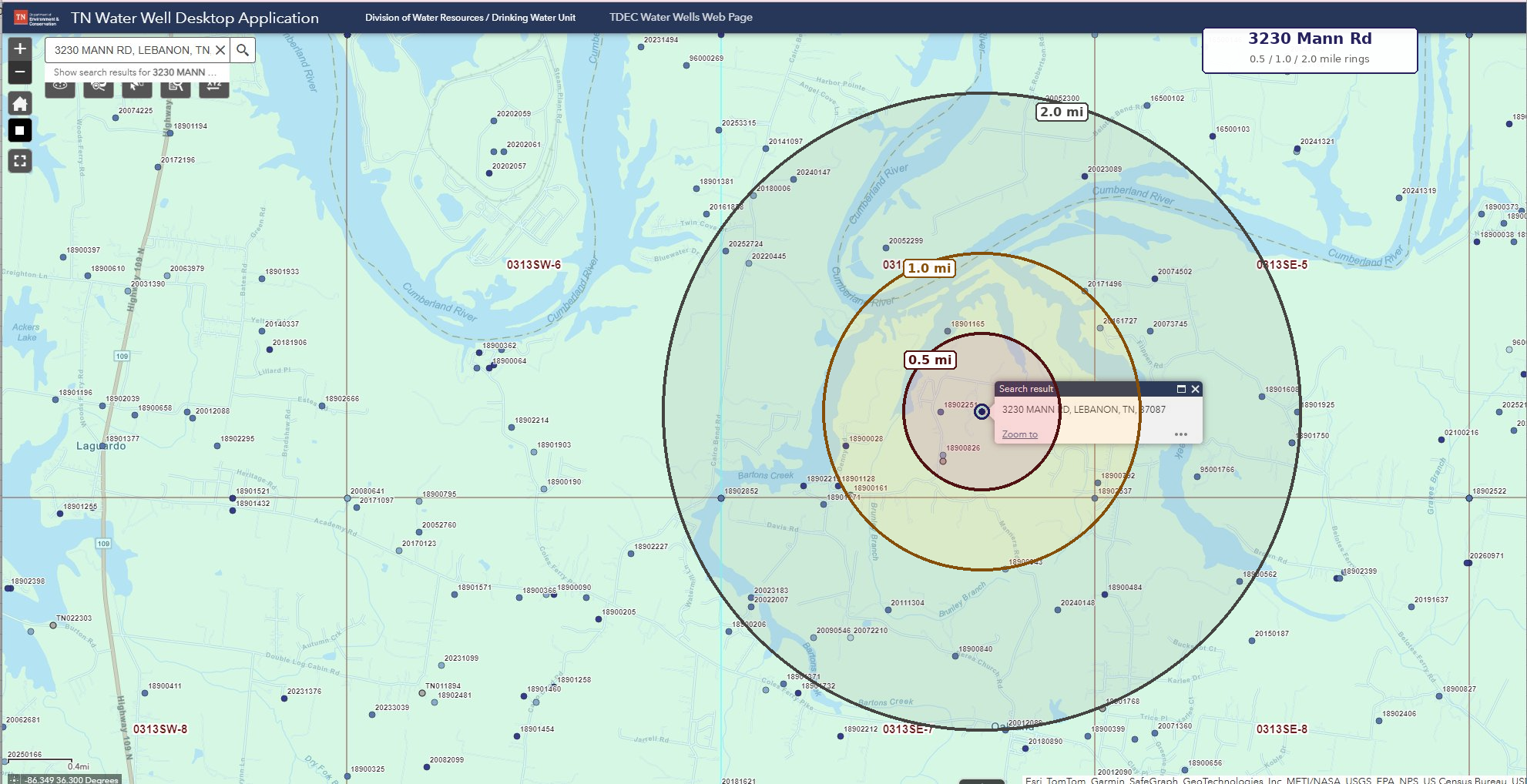
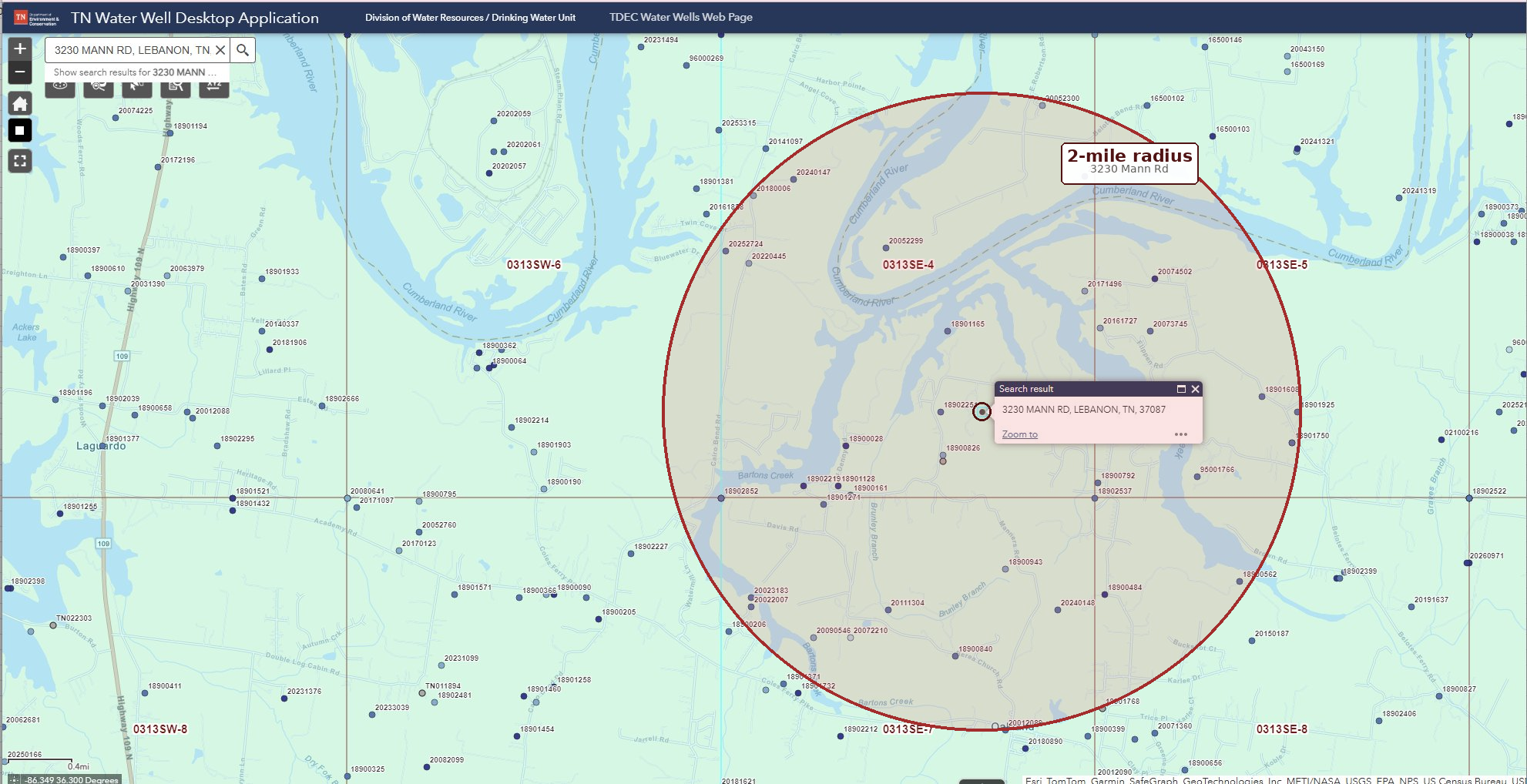
- Appendix C — Hydrological exposure analysis, including 38 documented private wells within the 2-mile contamination radius and the LaGuardo Utility District karst-fed water supply. Includes Exhibit C-1: a ring map of well locations.
- Appendix D — Septage receiving operations, truck-volume calculations for Wilson County, and formal disclosure requests regarding the operational configuration of the new plant. Includes Exhibit D-1: Mann Road field measurements (June 4, 2026) documenting actual road widths of 17–18 ft at four locations.
- Appendix E — Effluent force main (F1/F2) reclassification engineering risks. Documents the engineering and regulatory consequences of repurposing the existing 30-inch effluent force mains to carry raw sewage upstream of the new plant.
- Appendix F — Treatment technology and site footprint analysis. Identifies the disclosure gap in the city's 60-acre minimum acreage requirement and the matrix implications.
- Appendix G — Shortlisting methodology and procedural safeguards. Documents the Pugh-matrix-style requirements for defensible site elimination and recommends specific procedural safeguards. Attribution to Anthony Murphy, who first raised the shortlisting safeguards concern in the public record at the June 2, 2026 committee meeting.
- Appendix H (new in Rev C) — Columbia Gulf Transmission gas pipeline asymmetry. Documents that the same pipeline class cited as a deprioritizing factor for the Rockwood site crosses the Mann Road / Berea Church Road / Maple Hill / Coles Ferry Pike corridor.
- Appendix I (new in Rev C) — Biosolids disposal: traffic impact and infrastructure disclosure gap. Documents the current plant’s on-site gasification system, estimates outbound truck volumes at 20 MGD, and identifies the undisclosed biosolids management method as a material omission in the public record.
Formal requests summary
- All formal requests for disclosure and committee action — 35 discrete requests drawn from the oral remarks and Appendices C through I, organized by section. A quick-reference index of what the petitioners have asked the committee to enter into the public record before any elimination vote.
Exhibits
Earlier revisions
-
Public Record Statement, Revision A
(DOCX, May 27, 2026 — Filed)
The original filed statement, focused on the Mann Road and Berea Church Road addresses.
Superseded by Rev C for formal purposes but preserved here as the version on file with the
City of Lebanon. Currently endorsed by approximately 200 residents. Note: Appendix A listing
endorsing residents is part of the city's formal record and is not published here.
Add your endorsement →
Open Letter to the Committee (draft for public review)
-
Open Letter to the Site Selection Committee
(PDF, draft for public review, pending formal submission)
A separate filing addressing the ethics and priorities of the site selection process — matters of conscience that the technical Public Record Statement does not carry. Prepared by Todd Roark, Tich Chaikumnerd, and endorsing residents.
Add your endorsement →
Additional Information and Resources (currently not planned for submission)
Site selection committee meeting videos
City Council meeting videos
Additional submissions to the public record
-
Scoring Matrix Categories — June 2, 2026
(PDF, June 15, 2026 — Filed) — Documents the five screening categories confirmed in use at the June 2 committee
meeting, with observations on procedural gaps: the absence of anchored scoring rubrics, the
incomplete environmental data at the screening stage, the 60-acre minimum and its
technology dependency, and the proposed renaming of category 5 from “Service
Efficiency” to “Force Main Proximity.” Related to Appendices F and G of the
Public Record Statement.
-
Treatment Technology and Cost: A Review of the CAS Cost Baseline
(June 29, 2026 — Presented for public record) — Examines whether the cost comparison underlying the committee’s
60-acre site threshold reflects Lebanon’s actual regulatory requirements. Uses the
city’s own NPDES permit and peer-reviewed literature to show the published CAS cost
advantage applies to a basic secondary treatment baseline, not the biological nutrient
removal capability Lebanon’s permit already requires. Includes a formal request for
disclosure of the technology specification and a complete cost comparison before site
elimination.
-
Does the City of Lebanon Have an Interest in How Their Tax Dollars are Being Proposed to be Spent?
(Terry Monahan — Presented for public record June 29, 2026) — An independent analysis by Lebanon resident Terry Monahan making the fiscal case against siting a new conventional activated sludge plant on a remote 60-acre parcel. Identifies cost categories not fully accounted for in the committee’s deliberations: remote-site connection costs of $1–$20 million (a range the committee’s own engineer presented), land acquisition at Wilson County average values (~$2.56M for 60 acres), three-phase power extension of unknown cost, and public road improvements. Notes that CAS operation and maintenance is estimated at 50–60% more expensive than biofilm reactor technology, and that biofilm reactor upgrades to the existing plant could increase throughput without a new site, eliminating the remote-site capital cost categories entirely.
-
The Necessity Defense: What Tennessee’s 2024 Eminent Domain Amendment Means for Rural Landowners
(June 2026 — In work / for review) — Examines a 2024 change to Tennessee law
(T.C.A. § 29-17-107, Ch. 748) that may have removed the right of property owners
to challenge whether a condemnation is necessary when the project is a sewer or utility
facility. A WWTP is a sewer project. If Lebanon selects a rural site and moves to condemn
land, the affected owners may be limited to contesting the compensation amount — not
whether the taking should occur at all. Discusses the two-tier system the amendment appears
to create, what legal options may remain, and the case for a non-parochial legislative fix
that restores equal treatment for all Tennessee property owners.
-
Site 22 (Maple Hill Road) — Independent Analysis
(July 2, 2026 — Pending submission) — An independent measurement using the Tennessee Property Viewer (tnmap.tn.gov) finds that the existing force main runs through adjacent Site 8 on Maple Hill Road, placing the round-trip pipe run at approximately 8,300 feet — not the 25,000–30,000 feet stated by engineer Steve Jones at the June 29 committee meeting. Includes GIS map images, verbatim transcript citations from the June 2 and June 29 meetings, and questions for the committee regarding the discrepancy’s effect on the second-round cost scoring criterion.
-
Criterion Injection: When Informal Judgment Overrides a Formal Process
(June 2026 — In work / for review) — Examines a structural vulnerability in two-stage scoring
processes: the possible introduction, at a later informal stage, of evaluative factors that
were not part of the publicly stated framework. In a process like Lebanon’s, the formal
scoring matrix may be only the first stage; the deliberations that follow are possibly applying
criteria and information the committee has not disclosed to the public. A selection process
that works this way is at risk of producing an outcome whose actual basis cannot be audited,
contested, or traced in the public record — even when the first-stage scoring was
conducted transparently and in good faith.
Legal representation
Public records requests
Field observations and measurements
-
Mann Road Street Widths — June 4, 2026
(PDF) — Field measurements at four locations along Mann Road (675, 945, 1181, and 1323 Mann Rd)
showing actual road widths of 17–18 ft, alongside the engineer’s June 2 statement that the road
is “about 24 ft wide” and “not designed for large dump trucks.”
-
Eagle near Nest — 1409 Breyerton Way (Site 1) — June 16, 2026
(PDF) — Photographs documenting an eagle observed near its nest within the lot boundaries of
1409 Breyerton Way, a Site 1 candidate parcel, with a map identifying the location.
How to contact the petitioners
The submitting petitioners are Todd Roark, Tich Chaikumnerd, and the concerned residents and
property owners listed as endorsers in Appendix A of the May 27, 2026 Public Record Statement
(Revision A). To be added as an endorser, to share additional information, or to coordinate on
upcoming meetings, use the contact form on this site.
Revision history
- Rev C (June 15, 2026 — Filed) — Site count updated from 15 to 19 reflecting new sites added at committee-member request on June 2; septage analysis reframed; treatment technology disclosure updated; Columbia Gulf Transmission gas pipeline asymmetry documented (new Appendix H); biosolids disposal traffic impact and infrastructure disclosure gap documented (new Appendix I).
- Rev B (June 2, 2026 — superseded by Rev C) — Scope expanded from 2 sites to 7 sites; property value analysis quantified; hydrological exposure documented; septage operations and force main reclassification analyzed; treatment technology disclosure gap identified; shortlisting safeguards proposed.
- Rev A (May 27, 2026 — Filed) — Original Public Record Statement, focused on Mann Road and Berea Church Road addresses.
A note on accuracy: These materials are prepared in good faith and reflect the
petitioners' best understanding of the public record and supporting technical literature at the
time of publication. Where the materials make inferences about the city's plans, those inferences
are documented within the relevant appendix along with the basis for the inference. Corrections
or additional information from anyone with first-hand knowledge of the proceedings are welcome.